

AudioScape EQP-2A Stereo Valve Equaliser
AudioScape's new Pultec-inspired rack is a no-compromise stereo take on the classic passive equaliser.
By Matt Houghton
Published March 2026
Arguably the most famous of all analogue equalisers, the Pultec EQP-IA is a passive, valve-amplified design that was also among the first EQs to see regular use in the music industry. The earliest version was introduced as the EQP-I in 1953, and variants of it remained in production until 1981. Familiar as it now is to many of us (thanks in no small part to the number of DAW plug-in emulations of it), it has to be said that this two-band EQ is a pretty quirky design. Thankfully, the quirks proved very useful, most notably the so-called 'Pultec trick' whereby dialling in LF shelf attenuation and an equal shelving boost at the same frequency doesn't simply cancel out, but rather creates a slight dip just above the boost, which makes it quick and easy to dial in meaty low-end boosts without things becoming too 'flabby' or 'muddy'. It's far from a one-trick pony, though, and also contributing to its popularity are a pleasing harmonic distortion that's introduced even with no cuts or boosts applied, and the fact that even the tightest of bells in the upper band are pretty wide.
It's actually pretty hard to dial in a bad result accidentally, then, and the EQP-IA has proved enduringly popular among recording, mixing and mastering engineers. When original units occasionally come up on the second-hand market, they fetch eye-watering sums, so it's hardly surprising that several companies make products based on this vintage design. Some attempt, as far as possible, to be no-expense-spared clones, while others are more loosely based on it, aiming either to embellish it with greater functionality or to make the technology available for a lower price.
Two cool
Based in Florida, USA, AudioScape are one of the more recent companies to base an outboard EQ on this vintage design, and they actually offer a few variations. All of them aim to deliver the Pultec's functionality and sound at a lower price... but not too low! While their prices are competitive, they're far from being in corner-cutting or bargain-basement territory. These are serious bits of professional kit, handmade by a small team in the US, using high-quality components, including new-old-stock valves. Under review here is their EQP-2A which, unlike most EQP-1A-inspired gear, is a stereo device, with a single set of controls operating a pair of well-matched channels.
Now, it's fair to say that there are some disadvantages to a dedicated stereo configuration: you can't, for example, use it to EQ two mono signals, such as you'd need to do if you wished to treat the Mid and Sides components differently. Hence, AudioScape recommend matched pairs of their EQP-A for multi-mono applications.
There are also a lot of pros though! The single control set means you can make broad-brush tonal changes to stereo material really quickly, without worrying about matching channel settings. It hogs only half the rack space that two mono versions would, and the cost per channel comes down too, with no sacrifice in terms of sonic performance. All this makes the EQP-2A a particularly appealing prospect for stereo-bus processing — though you can of course still use a single channel to process a mono source. You'd have no problem tracking a vocal through one channel, and then using the same device later as your stereo mix bus EQ.
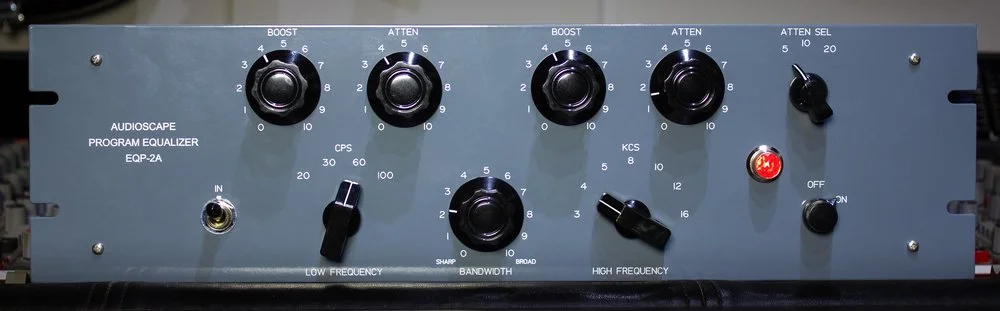
I have to say, my first impressions were very positive. The hardware has an air of solidity and quality about it. The 31J steel faceplate is nicely finished in battleship grey, and has no rough or sharp edges. Nor is there any flimsiness about the 13.25-inch (34cm) deep steel case, which has cooling vents on the top and on both sides. With no fewer than six valves inside, those are a necessity, and while the temperatures are not in egg-frying territory I'd suggest leaving a little space above the EQP-2A in your rack. On that note, it can take a little while for the valves to warm up and thus for the sound to stabilise; not a criticism, just an observation for those who are unaccustomed to working with real valves.
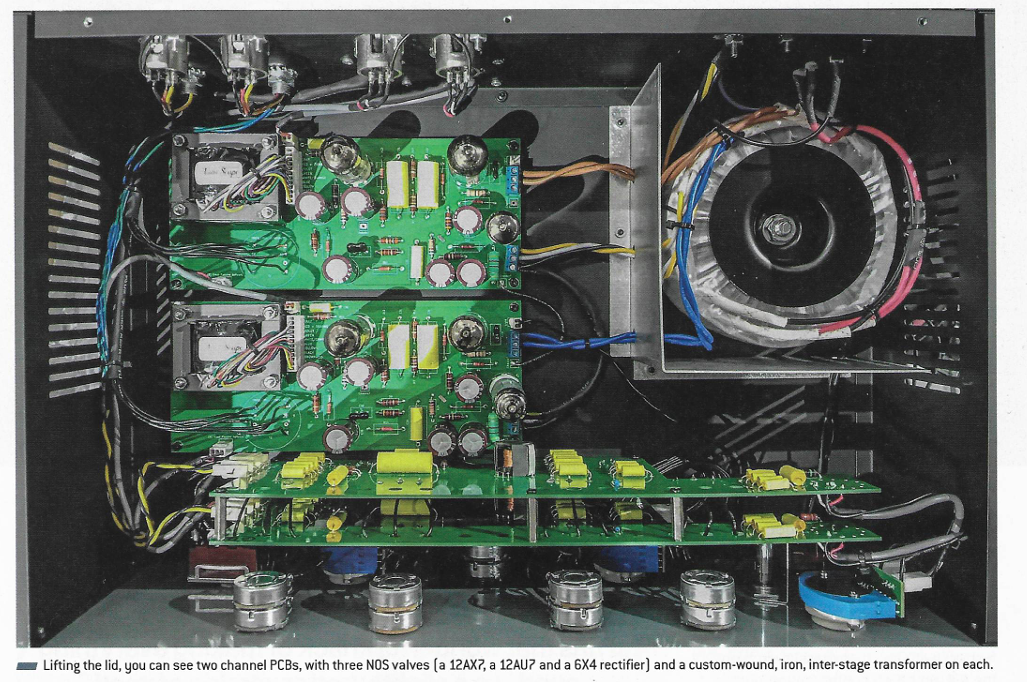
On the back are XLR sockets for the channels' I/O, which are balanced using four chunky, shielded transformers that protrude below. Mains AC is received through a standard IEC C14 socket, the voltage being stepped down by a large internal toroidal transformer that's also screened from the surrounding audio circuitry. There's plenty of space inside, where each channel's main circuit sits on its own PCB, and each channel also has its own vertically mounted board to link to the panel-mounted user controls. Amongst the traditional through-hole components that are used throughout (something I approve of — it should make servicing easier in years to come), there are two inter-stage transformers which, like the others, have been custom wound. All in all, it's very nicely put together; certainly a cut above the more inexpensive EQP-IA emulations I've seen.
On the back are XLR sockets for the channels' I/O, which are balanced using four chunky, shielded transformers that protrude below. Mains AC is received through a standard IEC C14 socket, the voltage being stepped down by a large internal toroidal transformer that's also screened from the surrounding audio circuitry. There's plenty of space inside, where each channel's main circuit sits on its own PCB, and each channel also has its own vertically mounted board to link to the panel-mounted user controls. Amongst the traditional through-hole components that are used throughout (something I approve of — it should make servicing easier in years to come), there are two inter-stage transformers which, like the others, have been custom wound. All in all, it's very nicely put together; certainly a cut above the more inexpensive EQP-IA emulations I've seen.
Returning to the front panel, the user controls are laid out in classic EQP-IA fashion, with an 'in' (bypass) switch on the left, an off/on control on the right, and the two EQ bands' controls between. The low band has a trio of knobs, the upper two of which turn pots to set the Boost and Atten(uation) on an undefined scale from 1-10, and the one beneath governs a frequency selector switch (20, 30, 60 and 100 Hz). The upper band has five controls: Boost (1-10) and Bandwidth (Sharp or O to Broad or 10) knobs for the boost, Atten (1-10) and Atten Sel (5, 10 or 20dB) knobs for the cut and a frequency selector switch that's common to both (3, 4, 5, 8 10, 12, 16 kHz). A large red jewel light glows when the unit is powered up.
Shapes & Colours
So what exactly do these controls do? The LF band's boost and attenuation controls both apply shelving filters, and as I suggested above they don't neatly cancel but interact in interesting ways. The precise effect of using both at once depends on your chosen settings. Dial in equal boost and cut and you have the classic 'Pultec trick' curve, for example, but less radical curves can be good too, particularly when working with the more complex material you'll encounter on a mix bus. In that context you can almost use Atten as a sort of slope control for the boost.
The upper band is different: Boost brings up a big, fat bell curve, and it's important to note that even the Bandwidth knob's Sharp setting (at O) is anything but narrow; this thing is always about painting with broad strokes of the brush! The Atten control is a high shelf, and its turnover frequency is shared with the bell's centre frequency, so there's still interaction between the boost and cut, just of a different nature to that in the low band. I tend to view the shelf as a means of taming top-end side effects, so allowing for more generous boosts, but it can be used alone to darken the top end.

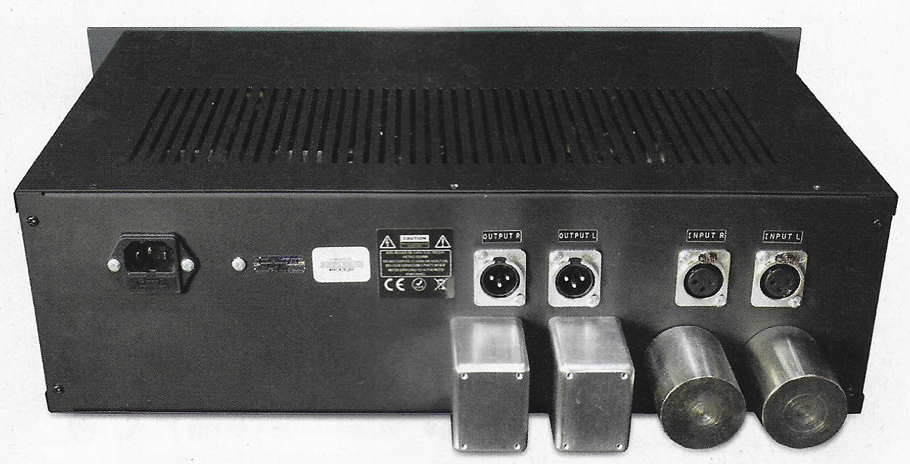
Four of the six audio transformers that contribute to the EQP-2A's character are shielded and protrude from the rear of the case. All the transformers have been custom-wound to match as far as possible the original spec.
Sound Judgement
To put the EQP-2A through its paces, I started by hooking it up to my DAW and using it on a few sessions. In that role, I found everything here I'd hoped for. I could radically revoice a kick drum, and not just its bottom end either: with all four filters in play, there's plenty of scope to create pretty complex curves that can, for example, embiggen the bass while simultaneously pulling back any woody lower mids, and making the beater's click more audible, without making the whole thing sound overly bright.
To be honest, I'd expected the EQP-2A to work well on kicks and other individual sources. But where it really shone was on the drum and stereo mix busses. It's important to understand that the EQP-2A is not purely about equalisation. There's a really pleasing harmonic distortion that's always added to the signal passing through an EQP-2A (as with any quality Pultec-inspired EQ), with both odd and even harmonics in the mix, but themusical-sounding odd ones dominating. In modern parlance, we're more in the euphonic 'saturation' territory than outright 'distortion' and it's utterly seductive. What you hear just seems that hint lusher, thicker and nicer all round: it has that wonderful knack of making everything sound like a slightly better version of itself — and that goes for complex material like full mixes as much as it does individual sources.
For the drum bus, I found enough scope with the EQ to shift the tonality in one direction or another to suit the mix, sometimes bigging up the bottom end, sometimes digging out a little space for the bass, vocals and guitars, and sometimes just to add a pleasing, smoothing sheen to the cymbals. On the mix bus, it's pure gold. You'll rarely need big dramatic EQ moves there, but the harmonics definitely add a pleasing character here, and if ever there were a place where shelving boosts or cuts could help, this is it.
I didn't have an original Pultec unit to compare this with, but I did pull up some of my favourite EQP-IA emulation plug-ins (specifically, UA's newest version and Acustica's Purple) for comparison. The overall sound of this hardware is a little less 'obvious' to my ears, and I mean that in a good way — think smooth, natural, elegant. 'Cleaner and sheenier' if you like, and it seemed way more forgiving when I dialled in very large boosts and cuts. I found the tactile experience much more enjoyable and immediate too — not just a taste thing, I genuinely find it really quick and easy to arrive at pleasing settings.
Over the course of the next few weeks, this unit was ever-present by my side, and I played lots of familiar commercial music through it while doing other things such as my SOS writing and editing work. This was material that had already been mastered, of course, but occasionally I'd reach out and adjust the balance of a track, just to see if I could improve on some facet of the mix. I always appreciated the subtle, classy character and smoothness. It was so easy to add a little bottom-end 'beef' to otherwise wonderful '80s mixes that had been mastered a bit bass-light for my taste, using the low boost to add 2-4 dB of extra weight with a 30 or 60 Hz shelf, and then just bringing up the LF Atten control the merest hint to tighten the result. Similarly, I found I had ample control over the very high end, when I wanted to bring up more of the air and sparkle. The upper band also proved adept at injecting a little attitude into some more recent folk-rock tracks that I know and love, but which feel just a little 'scooped' to my ears, and benefit from a more forward vocal sound. Importantly, flicking the EQ in/out is click-free, and that really helped me when assessing such things. The whole experience served really well to demonstrate that this unit should be capable of great things in a mastering context.
Verdict
I thought I understood the Pultec EQP-1A's virtues pretty well already, but my experience with AudioScape's EQP-2A made me rethink things a bit. I've tended to reach for Pultec-style EQs more for reshaping individual sources, and while the EQP-2A can do that perfectly well, it's also given me a new appreciation of their beauty on the stereo bus — it's like a tone control on steroids! In short, the EQP-2A has been beautifully assembled, and it delivers the goods. It sounds gorgeous, smooth, effortless... I know we can't all to spend this much to make things sound a touch nicer, but these nuances add up — and it's way less expensive than a pair of EQP-1As!